Robotics Engineering Student
at Arizona State University
Grand Challenge Theme
Joy of Living
Grand Challenges Scholars Program Digital Portfolio
Scroll Down
Hello, and welcome to my digital portfolio! I am Kushagra Dashora, a Senior pursuing my Bachelor's Degree in Robotics Engineering at Arizona State University. As I look forward to graduating in May 2026, I have spent the last four years actively participating in the National Academy of Engineering's Grand Challenges Scholars Program (GCSP). Before I joined this program, my perspective on engineering was almost entirely technical—I viewed it as the mere application of math and physics. However, the GCSP fundamentally shifted my mindset, challenging me to view engineering as a holistic, human-centered endeavor that must account for culture, business, and social impact.
My academic journey and this portfolio are deeply guided by the GCSP theme "Joy of Living." To me, this theme represents a lifelong commitment to developing technologies that actively enhance quality of life and restore independence, particularly for individuals facing physical and mobility challenges. Through my coursework and extracurriculars, I have constantly sought to align my technical robotics skills with this core philosophy.
As you scroll through this portfolio, you will find a curated, narrative reflection of my collegiate experiences. I have organized my journey across the five core GCSP competencies: Talent (mentored research), Multidisciplinary learning, Entrepreneurship, Multicultural awareness, and Social Consciousness (service learning). You will see how my experiences organically evolved from researching automated aerospace manufacturing, to developing affordable prosthetics, and eventually leading campus-wide student organizations. I invite you to read these reflections to understand how these interconnected experiences have comprehensively prepared me to tackle the grand engineering challenges of our future.
The GCSP is designed to prepare the next generation of engineers to address humanity's most pressing global challenges. To achieve this, the program requires scholars to step outside the traditional engineering curriculum and demonstrate significant growth across five interconnected competencies.
These competencies ensure that we do not just build technically sound products, but rather solutions that are viable and culturally responsible. We engage in hands-on research to develop our Talent, and take Multidisciplinary coursework to understand the historical and ethical implications of our work. We learn Entrepreneurship to ensure our innovations can successfully survive in the market, while developing a Multicultural perspective to guarantee those solutions respect global diversity. Finally, through rigorous Social Consciousness and service learning, we cement our ultimate responsibility to serve our local and global communities.

For my talent competency during my senior year (Fall 2025 to Spring 2026), I engaged in a comprehensive capstone research project collaborating directly with Wisk Aero, a pioneering company in autonomous electric aviation. Instead of working on theoretical classroom problems, my team was tasked with solving a highly practical and urgent manufacturing hurdle: designing an innovative Automated Battery Sorting System for their Generation 6 electric VTOL (Vertical Take-Off and Landing) aircraft assembly line. The existing factory automation required the manual separation of battery pouch cells based on embedded QR code data. This partial reliance on human intervention created a massive bottleneck, making the process far too slow to meet Wisk's aggressive, projected production demands over the next three years.
Taking on the role of Team Lead, I was responsible for guiding our multidisciplinary team through complex development timelines while personally focusing on the heavy technical systems integration. I specifically spearheaded the integration of a Siemens Programmable Logic Controller (PLC) to create a fully remote, Ethernet-based controlled factory system. By applying this Internet of Things (IoT) approach, I successfully connected the localized hardware directly to the broader network. This innovation not only removed the manual sorting bottleneck but transformed the entire robotic cell space into a system that is vastly more efficient, remotely accessible, and entirely ready to scale with Wisk's future demands.
This hands-on research experience was incredibly valuable in preparing me for my professional career. It effectively bridged the gap between the theoretical robotics I learned in textbooks and the practical, scalable manufacturing methodologies used in the real world. It taught me the critical role of IoT in modern industrial automation and gave me first-hand experience managing complex stakeholder expectations within the stringent safety protocols of the aerospace industry.
Furthermore, this project deeply aligns with my Joy of Living theme. By optimizing the manufacturing systems for electric VTOLs, I am directly contributing to the advancement and accessibility of sustainable, electric aviation technology. These autonomous aircraft represent a cleaner, faster transportation solution that will ultimately enhance human quality of life by drastically reducing urban commute times, decreasing our environmental carbon footprint, and radically improving overall urban mobility.
During my freshman year in Fall 2022, FSE 150 served as my formal gateway into the Grand Challenges Scholars Program. This course fundamentally shifted my academic mindset, teaching me to understand how engineering solutions carry wide-ranging, interdisciplinary implications that echo throughout society. Rather than focusing merely on math and physics, we spent the semester exploring the historical context, cultural impacts, and the profound ethical weight of emerging technologies.
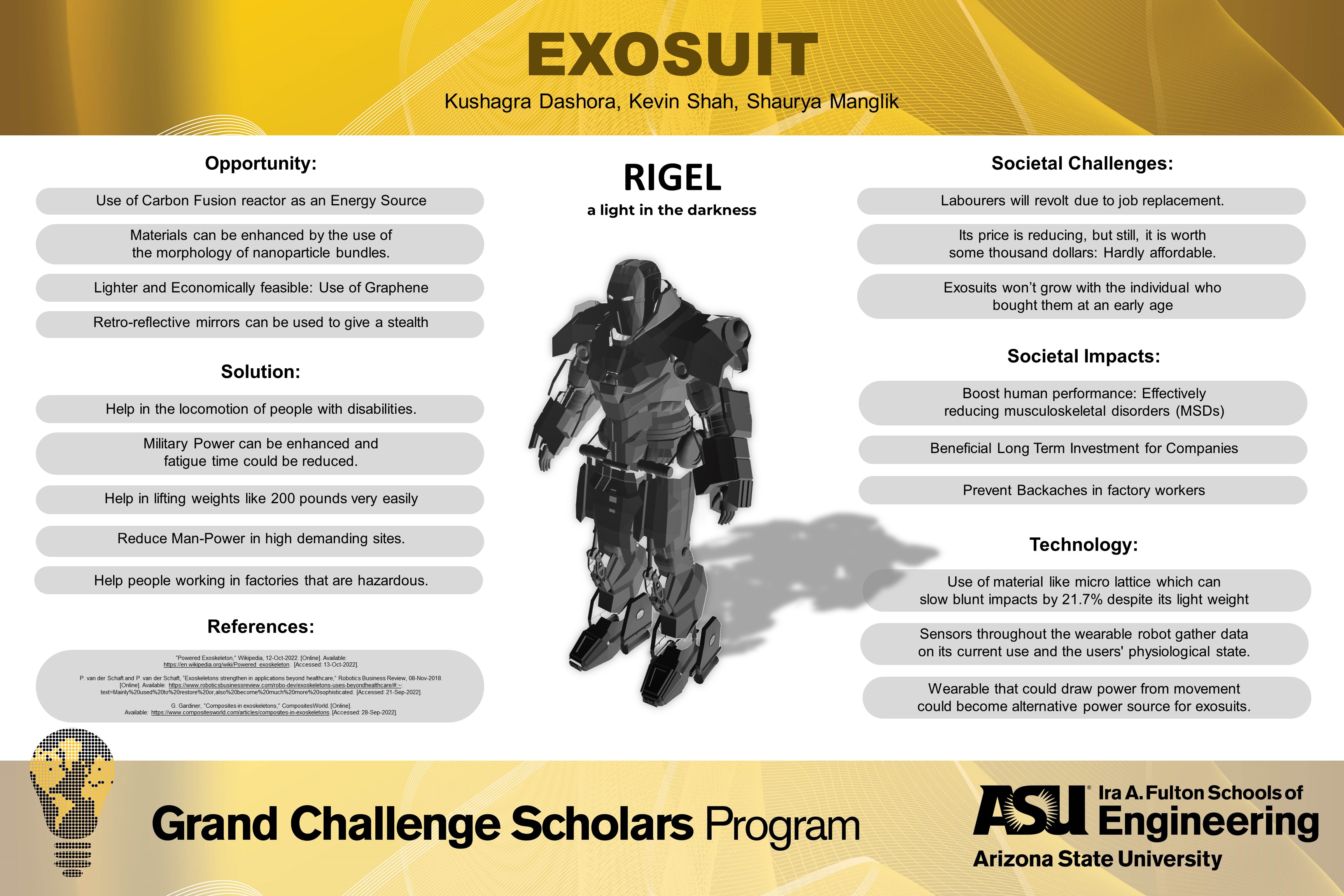
A particularly meaningful aspect of this course was a major project where I was tasked with designing a market-ready product that actively tackled a specific grand challenge. I took a central role in pitching and ideating the concept of a highly versatile, personalized exosuit designed to address two entirely distinct themes: Health and Security. From a health perspective, I conceptualized the mechanics of how the exosuit could assist amputees and individuals with mobility impairments, figuring out how it could help them regain their physical autonomy. Simultaneously, I explored the security standpoint, helping design the suit with military applications in mind to explicitly reduce physical fatigue and mitigate long-term injury among active-duty soldiers.
This project was my first true exposure to interdisciplinary problem-solving. It pushed me to look beyond current technological constraints and methodically approach complex, open-ended challenges—teaching me how to think like a professional engineer rather than just a student. Furthermore, the course was incredibly valuable because it familiarized me with the myriad of different resources, fabrication labs, and innovation programs ASU has to offer, establishing a vital foundation for my college career. By focusing on an exosuit that actively alleviates physical limitations and restores autonomy for amputees, my work on this project forged a direct, personal connection to my Joy of Living theme. It cemented my long-term passion for building tangible tools that fundamentally restore physical independence and enhance the daily human experience.
In Spring 2026, I completed HST 318, a transformative course that encouraged me to develop a true systems-thinking mindset. We transcended traditional technical boundaries to investigate how engineering has historically intersected with public policy, human behavior, and global economics. To explore this, we completed several impactful assignments. For instance, I wrote an analytical case study on the 1984 Bhopal Gas Tragedy. I examined how the disaster was not a failure of mathematical calculations—the safety systems were theoretically sound—but rather a catastrophic failure of human judgment, corporate negligence, and reckless cost-cutting. This deeply impactful assignment taught me that the ethical responsibility of an engineer extends far beyond correct equations; we must constantly advocate for inherently safer designs and prioritize human life over corporate profit.
Another standout experience in this course was writing my final essay, "Pragmatic Art," which required a deep dissection of Bill Hammack's book The Things We Make. Before taking this class, I held the rigid belief that engineering was strictly applied science—that if I could just grasp the core principles of physics, I could seamlessly apply them to create perfect objects. However, analyzing Hammack’s book completely dismantled this notion. I learned about how medieval cathedral builders relied heavily on heuristics, geometry, and simple rules of thumb rather than absolute scientific truths. Furthermore, learning that the steam engine was developed long before the science of thermodynamics could even explain how it worked fundamentally shifted my perspective on innovation.
This realization was incredibly liberating for my academic and professional career. It taught me that engineering is fundamentally an iterative process of trial, error, and optimizing competing constraints—much like how my own project teams have had to iteratively adjust physical robotic hardware after sensors unexpectedly failed in the lab. Developing this interdisciplinary systems perspective has taught me to abandon the immense pressure of achieving theoretical perfection on the very first try. Instead, I now embrace failure and collaborative problem-solving as highly necessary tools for innovation. This resilient mindset directly supports my Joy of Living theme. Developing life-enhancing assistive technologies rarely follows a perfect scientific formula; it requires constant, empathetic iteration with the end-users and a deep ethical commitment to their safety—lessons permanently ingrained in me by studying both the Bhopal tragedy and historical engineering methods.
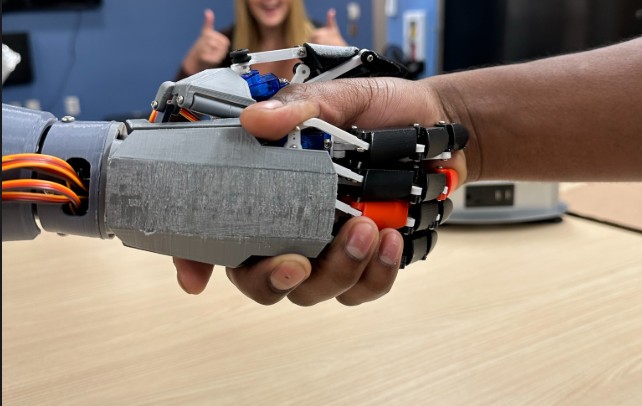
During the Fall 2024 semester, I enrolled in FSE 301, a course that became a pivotal turning point in my academic journey. It provided the exact framework I needed to take an ongoing technical team project—Devils Prosthetics—and transform it from a simple engineering exercise into a highly viable business venture. Devils Prosthetics is an initiative aimed at creating low-cost, 3D-printed myoelectric arms specifically designed for children who are trans-radial amputees. With standard medical prosthetics costing anywhere from $5,000 to over $100,000, our entrepreneurial goal was to drastically bring the cost down to a fraction of that price, making these vital tools accessible to households facing massive insurance coverage gaps.
Throughout the duration of this course, my role rapidly evolved from purely focusing on circuitry and engineering design to understanding deep market viability and the nuances of customer discovery. The experience taught me exactly how to analyze a target market, identify key demographic needs, and structure a sustainable business model around those discoveries. I practiced active listening and empathy by engaging directly with potential prosthetic users and their families, ensuring that we integrated their diverse functional and aesthetic needs into our core business models. I learned how to confidently pitch an idea by taking the lead in developing our Evidence-Based Pitch Deck, where we established a strategic, tiered product line. This line ranged from a $700 "BudgetBionic" baseline model to a $3,000 "BionicsRewired" advanced model. Designing this tiered structure was crucial, as it ensured our technology could bypass traditional healthcare insurance barriers and reach various economic demographics effectively.
This course was incredibly valuable to my professional career because it taught me the rare and essential skill of communicating complex technical visions to non-technical stakeholders and investors. By clearly outlining our value proposition, our unique market differentiation, and an actionable Institutional Review Board (IRB) approval roadmap for future human testing, our team successfully secured $10,000 in EPICS Elite Pitch Funding. This entrepreneurial experience is intimately tied to my Joy of Living theme. The "Joy of Living" is fundamentally about restoring independence and enhancing the human experience, but I realized that a brilliant engineering solution only achieves this if it can actually reach the people who need it. An affordable prosthetic confined to a university lab brings joy to absolutely no one. By learning how to analyze the market, pitch to investors, and secure funding, I gained the crucial business skills necessary to ensure my technical designs can survive in the real world. Ultimately, entrepreneurship is the necessary vehicle that delivers the "Joy of Living" directly into the hands of the end-users.
Engineering for the Joy of Living means engineering for a highly diverse, global population. For my specific work in robotics and prosthetics, cultural awareness is not optional; it is essential. Different cultures globally have vastly varying attitudes toward assistive technologies, aesthetic preferences regarding disability, and unique functional requirements based on their daily social traditions. My coursework in ASB 300 and SLC 212 equipped me with this critical multicultural perspective, ensuring I design with global empathy.
During the Spring 2025 semester, ASB 300 offered me a fascinating lens into how food serves as a foundational building block for understanding diverse social structures. I completed several immersive assignments to explore this. First, I conducted a participant observation at Infusion Coffee & Tea in Tempe, analyzing how the shop acts as a "third place"—a sociological concept describing a physical setting where community engagement and cultural capital flourish. Later, I completed a Food and Cultural Relativism project where I researched "bizarre" foods, specifically examining Sardinian Casu Marzu (maggot cheese) and global entomophagy (the practice of eating insects). Finally, I designed an Anti-Obesity Stigma Campaign aimed at healthcare professionals, structured to reduce weight bias in medical settings using interactive training and validated assessment tools.
These assignments radically shifted my cultural perspective. The cultural relativism project forced me to confront my own ethnocentric biases; I realized that labeling a foreign dietary practice as "strange" or "disgusting" simply stems from a lack of cultural context, as insect farming is actually highly nutritious and environmentally sustainable. The stigma campaign taught me how deeply ingrained biases can negatively affect how people are treated in medical and health-centric environments. Overall, the course taught me to view human practices as intricate cultural artifacts rather than simple biological necessities.
This cultural awareness is essential for my Joy of Living theme. Restoring independence and enhancing quality of life through robotics and prosthetics is not a one-size-fits-all endeavor. Different cultures have varying aesthetic preferences regarding disability and unique physical needs based on their traditions. Learning to actively overcome my own ethnocentric bias ensures that my future engineering designs will be culturally empathetic, highly inclusive, and genuinely capable of improving the human experience across global boundaries.
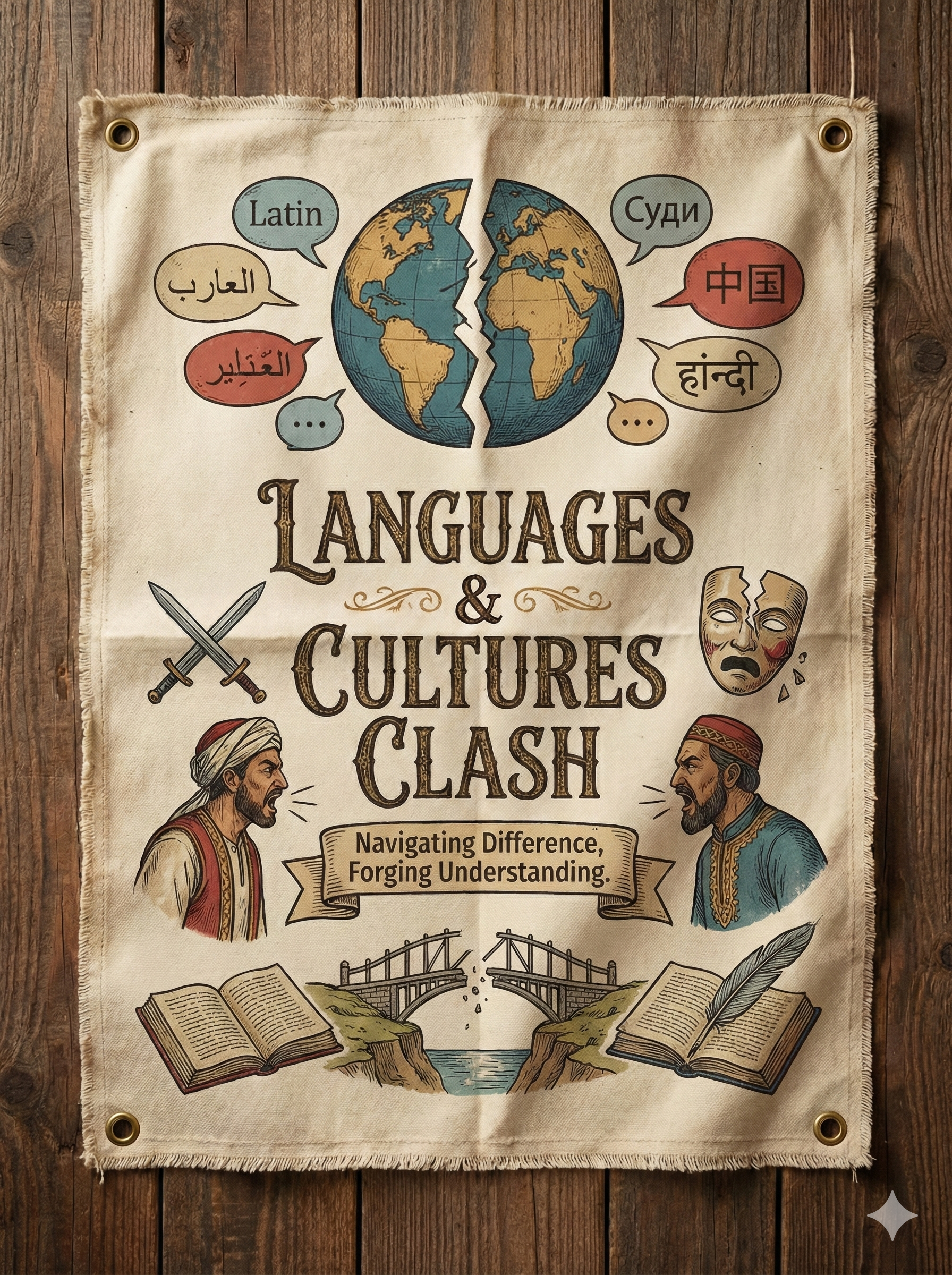
In the Fall 2025 semester, SLC 212 provided an in-depth examination of how language profoundly shapes cultural identity, and how subtle miscommunications lead to conflict. I completed several analytical projects exploring these dynamics. In one assignment, I analyzed the cultural identity markers within university education, specifically contrasting the "precision culture" and linear time-management of Engineering majors with the flexible-time culture of Humanities majors. In another, I interviewed an Indian physics professor to dissect intercultural miscommunications in academia, analyzing clashes regarding "Anglo scripts"—such as misinterpreting an indirect "soft no" or viewing silence as disengagement rather than a sign of hierarchical respect. Finally, I explored the deep cultural schemas of India, such as the "clean/unclean" hand dichotomy and the Atithi Devo Bhava (guest is God) hospitality script.
This course taught me the vital concept of "metacultural competence"—the conscious ability to view my own conceptualizations as non-universal. By contrasting the engineering subculture with others, I learned how to recognize my own professional biases. It taught me vital strategies for decoding cultural scripts, transforming my reaction to unfamiliar customs from labeling them as "weird" to understanding them as simply "different." I learned that fluency in English does not equal fluency in American cultural scripts, and that true communication requires active empathy.
Developing metacultural competence is absolutely vital for my Joy of Living theme. To build life-enhancing, assistive technologies, I must seamlessly collaborate with diverse, international engineering teams and navigate the varied work styles of global peers. Furthermore, the interfaces and user experiences I design must respect varying cultural norms. Understanding how to mitigate intercultural friction ensures that the technologies I create to restore independence are universally accessible and respectfully integrated into users' daily lives.
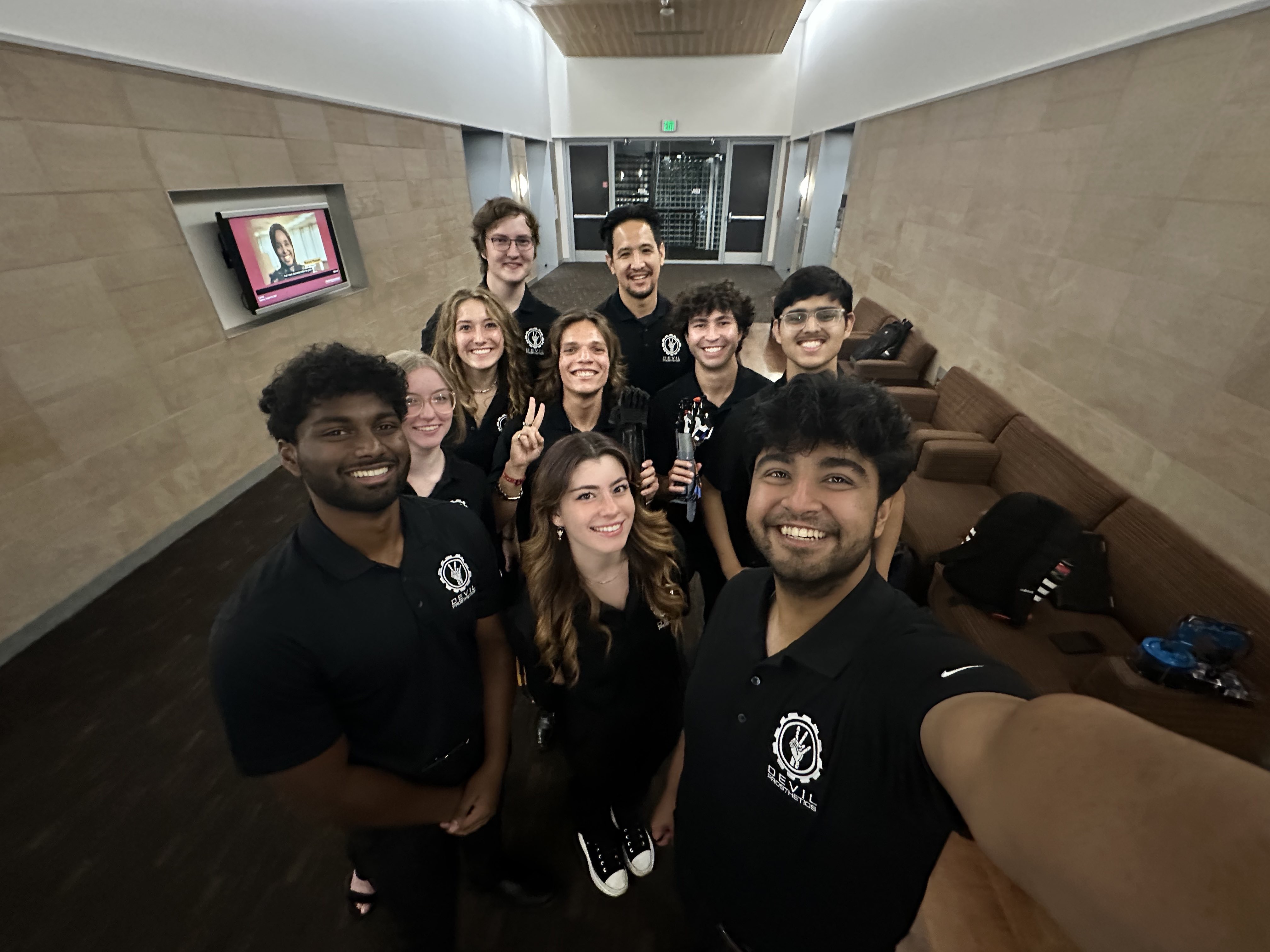
From Fall 2023 to Spring 2024, I fulfilled a major portion of my service learning through the Engineering Projects in Community Service (EPICS) program. EPICS is an award-winning social entrepreneurship platform where student teams design, build, and deploy complex systems to solve engineering-based problems for local charities and communities. Serving as the Electrical Design Lead for Devils Prosthetics, my core focus was on developing an affordable, 3D-printed myoelectric prosthetic specifically tailored for children facing upper-limb loss.
In this role, I took charge of designing the intricate electrical controller system from the ground up. I specifically engineered the servo control mechanisms, utilizing microcontrollers like the Raspberry Pi Pico alongside analog EMG sensors to successfully capture and translate electrical muscle signals into physical, articulated hand movements. Beyond the electronics, I also actively contributed to the mechanical design by iteratively modifying the 3D-printed PETG models of the arm. My personal design process was heavily iterative; I constantly refined the socket fit and EMG sensor placement based on direct trial and error. Mastering these new CAD, circuitry, and soldering skills required me to work closely with a diverse group of mechanical engineers and computer scientists, teaching me how to effectively communicate electrical constraints to software and hardware sub-teams.
However, the most impactful aspect of this entire experience was the direct collaboration with my community partner, Noah Nemgar, a Certified Prosthetist Orthotist at Limb Labs. Through direct consultations with Noah, I learned the critical importance of patient comfort, the physical nuances of socket fittings, and the heavy emotional weight of limb loss—deep, human insights that raw data and textbooks simply cannot teach. This experience went far beyond technical execution. I grew so dedicated to this mission of social consciousness that I took an active role in navigating the complex legal and operational steps to transition our student project into a registered non-profit LLC. For me, the true value of this experience was realizing my work could have a tangible impact on an individual's physical independence. This hands-on service perfectly encapsulates my Joy of Living theme, demonstrating how engineering, when guided by pure empathy and community partnership, can directly restore joy and autonomy to those facing physical hardships.
My second major service commitment was bridging communities as a Fulton Ambassador, a vital university organization that acts as the primary link between prospective students, donors, and the broader public to the vibrant engineering community within Arizona State University. Spanning three and a half years of my college life—from Fall 2022 through Spring 2026—I consistently dedicated my time to this organization, eventually evolving into high-level leadership roles, serving as both the Poly Co-Tour Director and the Polytechnic Campus President.
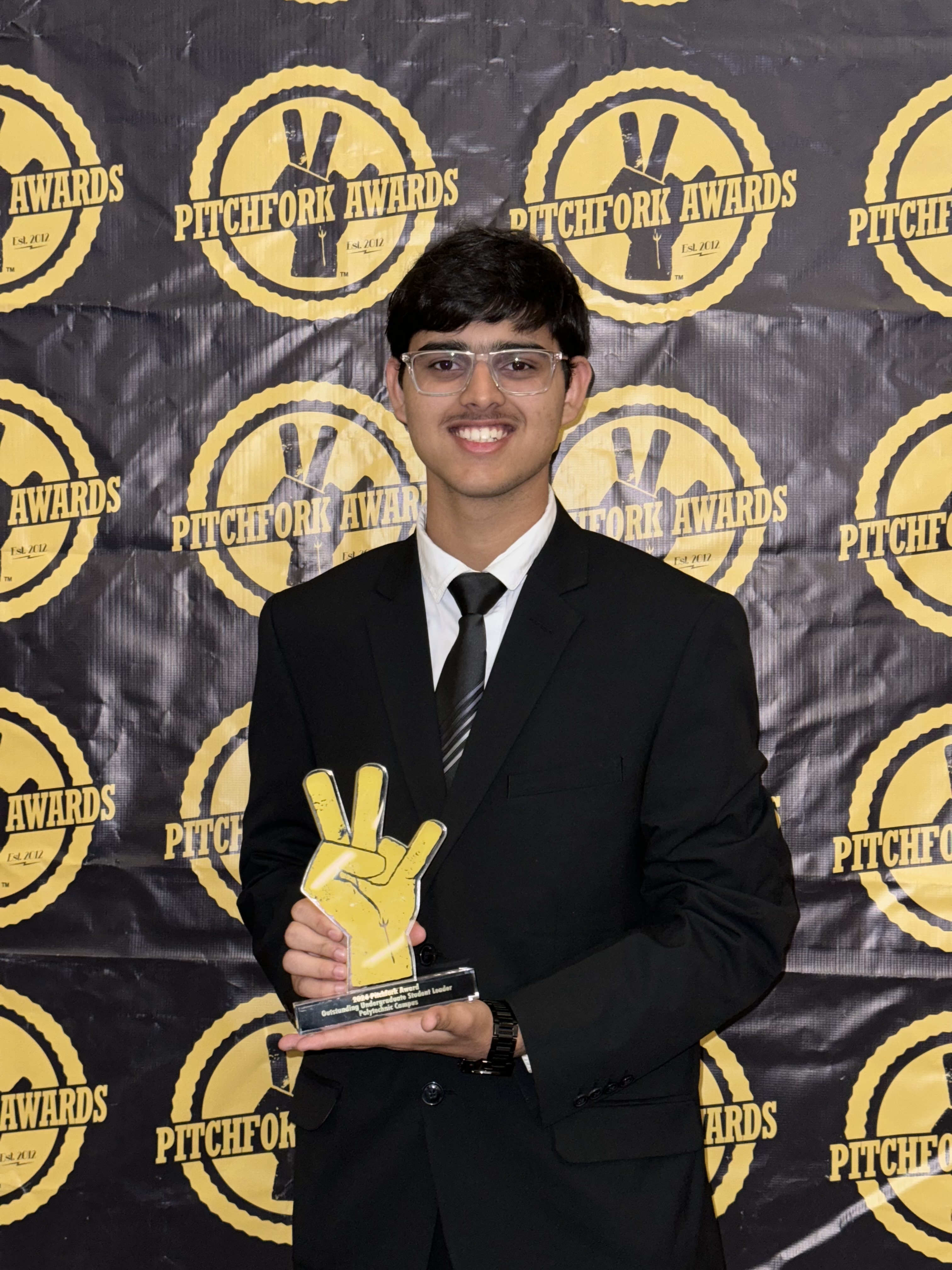
In these roles, I was essentially the human face of our engineering program. I gave countless campus tours, connected personally with Fulton donors at official networking events, and mentored local high schoolers who were curious about STEM. One of the most fulfilling parts of this service was continuing to guide and advise many of these students even after they enrolled as college freshmen, watching them grow into capable engineers. Helping young students realize their potential in higher education was incredibly rewarding. For my unwavering dedication to representing the school and leaving a lasting, positive impact on the culture, I was honored to receive both the Rookie of the Year and Best Legacy awards from the organization.
Both my rigorous time in EPICS and my extensive mentorship as a Fulton Ambassador directly embody my Joy of Living theme. These distinct experiences shifted my perspective from simply wanting to build advanced robots in an isolated lab, to engaging deeply and empathetically with the surrounding community. They proved to me beyond a doubt that the true, ultimate purpose of engineering is not just technological advancement for its own sake, but fostering genuine human connection and dedicated service to others.
My journey through the Grand Challenges Scholars Program has been a transformative experience that seamlessly weaves together diverse academic disciplines under the unifying theme of the Joy of Living. When I first started my engineering education, my focus was largely confined to technical execution—I exclusively wanted to know how to code, solder, and build machinery. However, participating in the GCSP required me to step back and view engineering as a massive, multidimensional tool for human betterment. The connectivity between the five competencies has been the most profound realization of my entire college career.
This deep connectivity is vividly evident in how each competency built directly upon the others. My talent competency—researching automated manufacturing and IoT integration for Wisk Aero—gave me the hard, rigorous technical skills necessary to build complex systems. But it was my multidisciplinary coursework in history and science fiction that taught me to view those technical systems through an ethical lens, ensuring my designs are socially responsible and grounded in historical reality. When I took those technical skills into the service learning environment of EPICS to build prosthetics, my multicultural understanding gained from studying global food and language clashes ensured I was designing with cultural sensitivity and empathy for the end user. Finally, my entrepreneurial training provided the vital business acumen necessary to actually bring those prosthetics out of the lab, secure thousands of dollars in funding, and navigate the transition into a non-profit LLC.
Together, these highly interconnected experiences have prepared me exceptionally well for my future career. I am leaving Arizona State University not just knowing how to program a Microcontroller or physically build a robotic arm, but knowing how to lead multidisciplinary teams, communicate effectively with global stakeholders, and center the human experience in all of my designs. The GCSP has transformed me from a student focused primarily on technical skills into a well-rounded, highly adaptable robotics engineer prepared to tackle humanity's greatest challenges head-on.
Overall, the Grand Challenges Scholars Program has been the defining pillar of my undergraduate education. The program's structure is excellent, but if I were to offer constructive feedback for program improvement, I would highly recommend creating more structured, interdisciplinary networking events. Specifically, events where GCSP scholars working on vastly different themes (such as Sustainability and Joy of Living) are tasked to collaborate on rapid micro-projects. This would foster even deeper cross-pollination of ideas and allow scholars to practice their interdisciplinary skills in real-time, simulating the diverse environments we will face in the professional industry.